The Inference Inflection and the Token Economy - GTC 2026
Jensen Huang’s GTC 2026 keynote reframed AI economics: the bottleneck is no longer model training, but how cheaply and quickly systems can produce useful inference at scale.
N NOR-TIC5 min read
Strategy
NVIDIA
Inference Economics
Enterprise AI
Summary & background
Technical Context:
This analysis tracks NVIDIA’s shift from chip-centric messaging to full-stack architecture strategy, where token production becomes the core business unit. For non-technical teams, the immediate question is practical: where can you deploy agentic workflows now to reduce cycle time and decision latency?
The keynote’s most important claim is that AI has crossed into an inference-first era. Over roughly two years, demand for compute expanded by a reported million-fold, and the center of gravity moved from occasional model training runs to continuous model reasoning in production. That shift matters because every business process now competes on response quality, latency, and cost under real workload pressure.
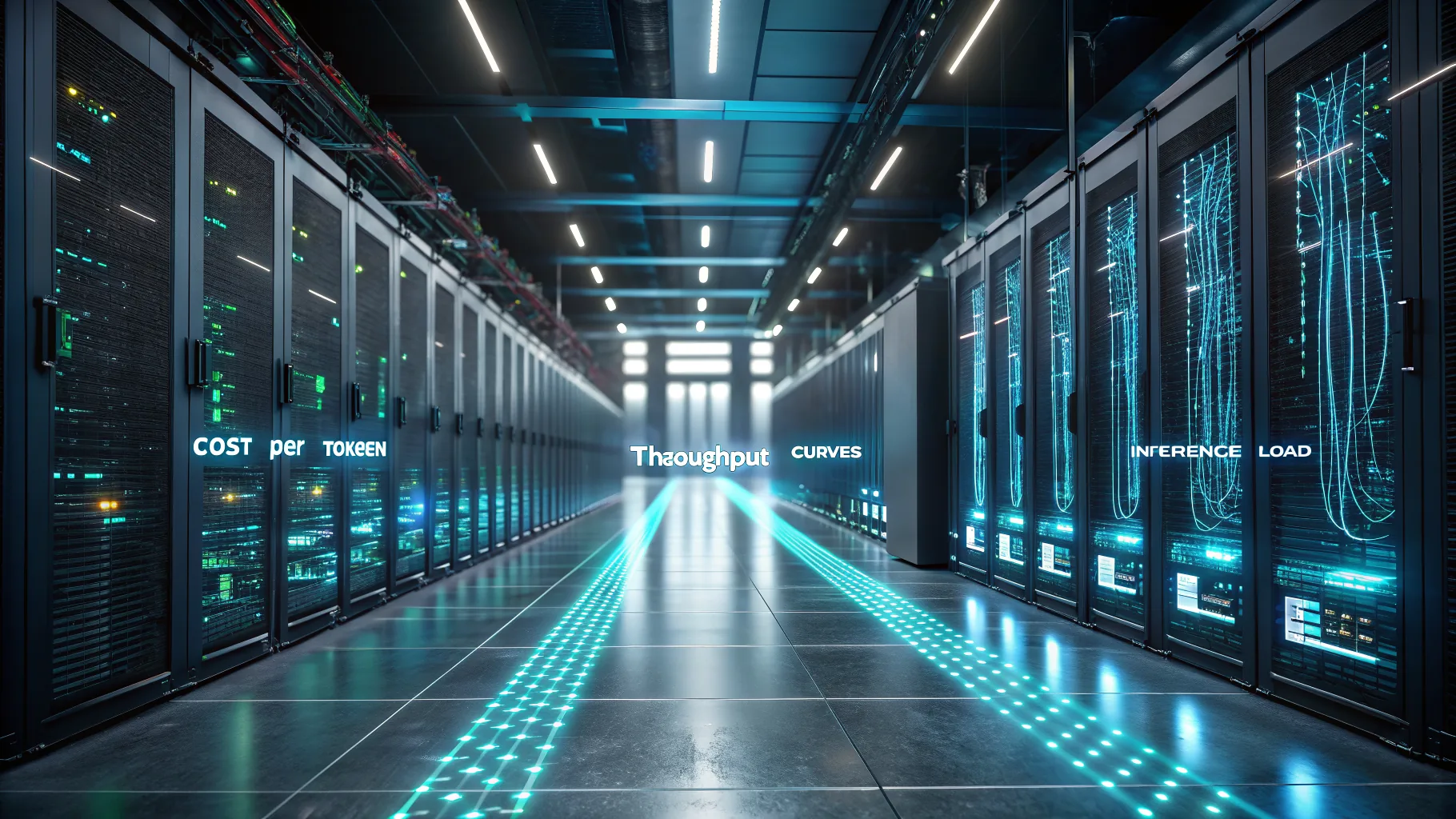
NVIDIA’s metaphor of the data center as a token factory is not just branding. It introduces a measurable operating model: how many useful outputs can your stack deliver, and at what unit cost? In practice, this means architectural choices outrank component choices. Cheap parts do not produce cheap outcomes when orchestration, memory flow, and software coupling are inefficient.
For general audiences, the takeaway is direct: AI value now comes from repeatable throughput, not demos.
01Architecture Shift
Old AI Infrastructure Lens
Teams optimized around model training milestones, GPU procurement cycles, and benchmark wins disconnected from production behavior. Success looked like model completion, not operating economics. Data centers were treated as storage-and-compute backends, with software often bolted on later.
Inference Inflection Lens
Organizations optimize for cost per token across real enterprise workloads. Success is measured by sustained inference throughput, quality under load, and deployment velocity. Data centers operate as industrial token systems where software, networking, memory, and compute are co-designed from day one for economic efficiency.
Vera Rubin is presented as the strategic break from the “single chip hero” narrative. Huang’s framing signals that performance gains now come from end-to-end optimization across interconnect, software tooling, and workload scheduling, not isolated silicon advances. That is why the keynote repeatedly emphasized integration as a system property rather than a parts catalog.
The economic argument is even sharper: in gigawatt-scale facilities, architecture is the primary determinant of viability. NVIDIA’s line that even free hardware can still be “not cheap enough” captures a hard truth for operators: if your stack burns energy, memory bandwidth, and developer time inefficiently, total token output suffers.
For planners outside engineering, this translates into procurement discipline: evaluate full workflow cost, not unit hardware price.
Token Factory
INFRASTRUCTURE MODEL
Data centers are positioned as production systems whose output is tokens, not just compute availability.
Lowest Cost per Token
PRIMARY ECONOMIC KPI
Architecture selection is framed as the single most critical lever for gigawatt data center economics.
Vertical + Open
INTEGRATION STRATEGY
NVIDIA optimizes silicon-to-software internally while enabling broad partner integration externally.
02Agentic Enterprise Playbook
What non-technical teams can build in the next 90 days
Start with one repetitive decision workflow—customer support triage, internal policy Q&A, or procurement document routing—and instrument it as an agentic pilot. Define success as reduced turnaround time, fewer handoff errors, and traceable decision logs, not “AI adoption” as an abstract goal.
Use open models for low-risk experimentation, then add higher-performance components only where quality or latency creates measurable business impact. The practical win is a workflow-level ROI loop that finance, operations, and product can all validate.
Step 1
Training-Centric Phase
AI value is concentrated in model development cycles and benchmark races; production inference remains secondary.
Step 2
Inference Inflection
Demand explodes and systems must think, read, and act continuously in live environments; token economics become central.
Step 3
Vera Rubin System Era
NVIDIA shifts emphasis from component storytelling to integrated architecture spanning software and hardware as one unit.
Step 4
Agentic Enterprise Expansion
Toolkits such as Nemo, NemoClaw, and Agentic AI offerings support workflow automation across business software ecosystems.
Step 5
Physical AI Convergence
Simulation, physics-aware models, and manufacturing deployment combine to move robotics and autonomous systems into reliable operation.
Even free hardware is not cheap enough if the architecture is inefficient, because the goal is the best token cost.
Physical AI stack: from simulation to factory floor
NVIDIA’s robotics narrative connects three layers into one deployment path: physics-aware models, Omniverse simulation, and real manufacturing execution. The Newton solver, developed with Disney and DeepMind, runs on NVIDIA Warp and is designed to let robots adapt to real-world constraints after virtual training.
Physical AI models encode environmental behavior and motion constraints.
Omniverse provides risk-reduced training before any expensive real-world rollout.
Jetson-class onboard compute closes the loop from inference to actuation in deployed systems.
Named in keynote as a “ChatGPT moment” for autonomous driving reliability
The most durable strategic message is NVIDIA’s claim to be vertically integrated but horizontally open. Vertical integration delivers performance coherence from silicon through software. Horizontal openness makes that performance portable across partner ecosystems, industry contexts, and country-level deployment needs. Together, those ideas position NVIDIA as infrastructure rather than a narrow component vendor.
For the public and small organizations, the future is less about training frontier models and more about choosing the right operational surface: support, logistics, compliance, education, and healthcare coordination are all inference-heavy domains. Start where decisions are frequent and auditable, then standardize on metrics your team already trusts.
If 2024 was about AI possibility, 2026 is about economic execution at token scale.