NOR-TIC Method:
In our 22-agent environment, trust is not a feeling and autonomy is not a compliment. We use decision logs, risk-classified gates, and tiered permissions to turn past performance into present operating authority.
We do not grant agent autonomy as a leap of faith. We grant it as a managed promotion path, where authority expands only after repeated performance proves that a specific class of work is safe, bounded, and worth delegating.
In our 22-agent environment, trust is not a feeling and autonomy is not a compliment. We use decision logs, risk-classified gates, and tiered permissions to turn past performance into present operating authority.
Most teams misdiagnose agent failure. They look at model quality first, when the deeper issue is usually trust design. If an agent can draft, classify, retrieve, and reason, but the organization has no clear rule for what it may do next, every handoff becomes improvised. That creates friction on good days and preventable risk on bad ones.
We have found a better framing: onboard an agent the way you onboard a capable new employee. Start with observation, move to supervised production, then allow bounded execution, and only then permit independent operation inside a tightly defined domain. That sequence matters. It gives teams a way to scale useful automation without pretending uncertainty has disappeared.
The payoff is practical. Review stops being a blanket habit and becomes a targeted control. Trust becomes cumulative, not emotional.
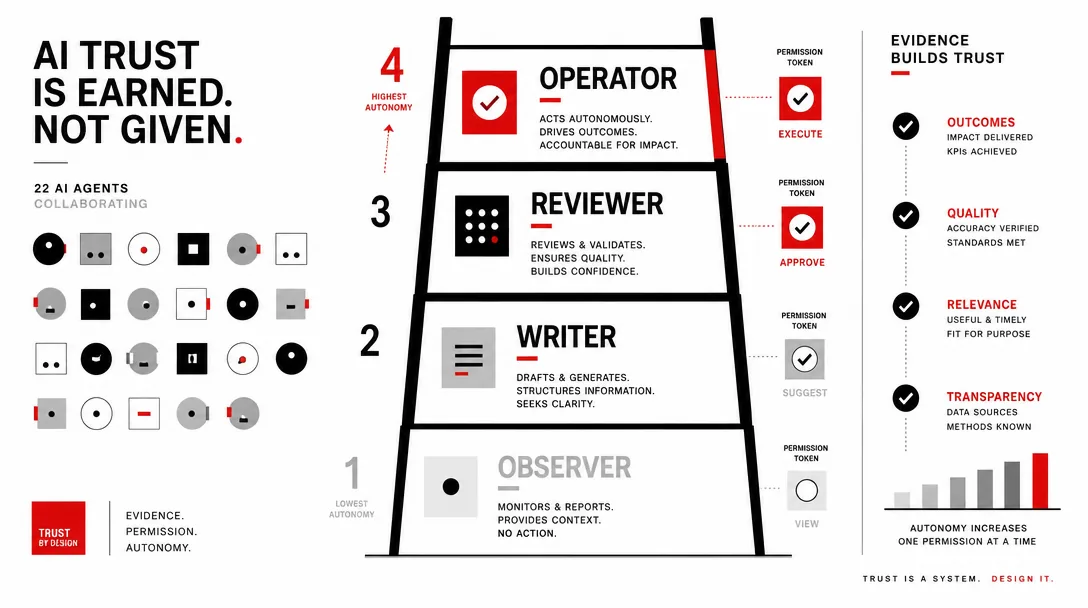
The wrong question is whether an agent is "in the workflow" or not. Binary rollout thinking forces teams into two bad choices: either keep the agent boxed out of real work, or hand it execution rights before governance is ready. In both cases, the organization learns slowly because there is no graduated path between no authority and full task execution.
That binary model also distorts how people interpret performance. A small mistake gets treated as proof the agent cannot be trusted. A few strong outputs get overread as proof it can handle everything. Neither conclusion survives contact with sustained operations. What matters is not whether an agent is good in general, but whether it is reliable within a defined task class.
This is why we use scaffolding for any capability-uncertain actor—new hires, contractors, junior operators, and AI agents alike. Bound the scope. Observe the work. Record the decisions. Expand authority only when evidence supports it.
Binary AI Rollout
Teams decide too early whether an agent is trusted or untrusted. Review becomes inconsistent, exceptions pile up, and low-risk tasks still require manual attention because nobody can explain where safe delegation begins. Permissions expand through enthusiasm and shrink through fear.
4-Tier Trust Ladder
Authority grows through recorded evidence. Each tier narrows the question to what the agent can safely do now, under what gates, and with what review posture. Governance becomes legible, promotion becomes repeatable, and human attention moves toward the work that actually deserves scrutiny.
If you give an agent tools before you define gates, you have not created autonomy—you have created cleanup work with a delay. Set the scope, escalation path, and intervention rule first. Then let performance determine how much freedom the agent earns.
A simple operating rule works well: if an action touches sensitive data, keep a human in the loop until the decision log shows a long, stable record of safe behavior. If it only touches internal documents, you can often move faster—provided exceptions are still recorded and reviewable.
The agent reads, summarizes, classifies, retrieves context, and drafts. It has zero write authority and zero send authority. Humans review every output before anything becomes action.
The agent produces work-product-grade material such as briefs, tickets, specs, summaries, or draft communications. The quality bar rises, but the send gate remains human-controlled.
The agent executes inside a bounded domain. Routine document actions may run autonomously, while higher-stakes or data-touching actions trigger gates and require review.
The agent operates without per-task approval inside a well-bounded domain because the performance record shows stable judgment, safe escalation behavior, and low error rates over time.
At Observer, speed is not the point. Evidence collection is. We want to know whether the agent understands the domain language, retrieves the right context, and produces drafts that are directionally correct. An agent can be weak at final execution and still create real value through extraction, triage, and first-pass synthesis.
At Writer, the standard changes. Usable output matters more than suggestive output. This is where the performance file begins to reveal asymmetry. One agent may be mediocre as a planner yet excellent at weekly summaries; another may be strong at internal specifications but unsafe for customer-facing communication. Narrow reliability is far more useful than vague impressions.
At Actor and Autonomous, boundaries become the product. Once an agent can take action, the central design question is no longer whether it reasons well. It is whether the action sits inside a risk category that has earned lower-friction execution.
0
Write authority. Outputs are reviewed before any downstream action.
1 gate
Human approval remains the release mechanism even when work-product quality is high.
Bounded
Execution is allowed only inside a clearly defined domain with risk-classified gates.
Aggregate review
Humans stop checking each transaction and review quality, exceptions, and drift over time.
Promotion should never depend on recent vibes. We review a defined task class and ask whether the decision record shows repeatable judgment under realistic conditions. The threshold is not perfection. The threshold is stable, understandable performance with contained failure modes.
Primary evidence source: decision_log
A flowchart showing an agent progressing from observation to autonomous operation, with gated decisions triggered when actions affect data, external communication, or predefined stakes thresholds.
Execution becomes dangerous when teams treat all actions as equivalent. A document update and a database write are both "actions," but they do not carry the same risk. When those differences are ignored, trust collapses because a low-stakes routine and a high-stakes exception travel through the same permission model.
Our operating rule is simple enough to apply consistently. If an action touches data, keep a human involved until the evidence base is strong. If an action touches documents, autonomy is often acceptable much earlier. If the action crosses a predefined stakes threshold—external publishing, sensitive changes, irreversible impact—a gate must fire and the intervention must be recorded.
That middle layer is where scalable operations are won. Boundary quality becomes decisive when agents gain more reach.
Autonomy is not a personality trait. It is a permission structure tied to a specific category of work where the performance record shows consistent success.
| Tier | Allowed Work | Human Role | Failure Containment |
|---|---|---|---|
| Observer | Read, summarize, classify, draft | Review every output before action | No direct writes or sends; containment is built into lack of authority |
| Writer | Produce briefs, plans, specs, summaries, draft tickets or copy | Approve release, assess quality trends | Send gate remains human; rework exposes repeat failure modes |
| Actor | Execute routine actions inside a bounded domain | Review exceptions, high-stakes triggers, and gate history | Risk-classified gates stop unsafe actions before they propagate |
| Autonomous | Run well-bounded operations without per-task approval | Review aggregates, drift, escalation frequency, and outcomes | Oversight shifts to system-level monitoring and periodic promotion audits |
Relative review load
A content-support agent is a useful example because the path to autonomy is easy to overestimate. At Observer, the agent reads source material, extracts themes, and drafts outlines. That already saves time, but the main gain is diagnostic: you can see whether tone drifts, factual retrieval weakens, or domain language gets flattened before any external consequence appears.
At Writer, the same agent can produce blog drafts, email copy, content briefs, and internal summaries that are close to publishable. Now the team should record what needed only light editing versus what demanded heavy revision. Those distinctions create the performance file that turns editing effort into governance intelligence.
At Actor, autonomy should remain bounded. Let the agent organize approved assets, update internal documentation, and assemble draft distribution plans. But if a step would publish externally, alter customer data, or trigger a live send, the gate must fire. That is how you preserve speed without confusing content operations with reputational risk.
At Autonomous, the agent no longer needs approval for every internal content operation inside that narrow domain. Humans step back from transaction review and examine weekly summaries, exception patterns, and scope drift instead. That is real delegation, not blind trust.
Pick one recurring task class and define its current tier explicitly. Then write down what would count as evidence for promotion: how many clean runs, what intervention rate is acceptable, and which failures are disqualifying.
Most teams do not need more prompts first. They need a cleaner permission model, a simple decision log, and one bounded area where trust can compound instead of resetting to zero on every task.
The strongest multi-agent environments are not built on optimism. They are built on operational trust—trust with shape, rules, history, and consequences. In our own 22-agent environment, coordination works because authority is structured, not because every agent is universally capable.
That is the shift leaders need to make. Stop asking whether an agent deserves trust in the abstract. Ask what domain it can handle, what evidence supports that claim, and what gate should catch the exceptions. Once trust is inspectable, autonomy stops looking reckless.
It starts looking like management.