Strategic View:
The real break is not better autocomplete. It is a management shift from protecting developer time to designing reliable loops for agent execution, human review, and rapid recovery.
Engineering teams are entering a new operating model: execution is becoming abundant, while judgment, validation, and coordination discipline are becoming scarce. The organizations that adapt first will not simply ship more code; they will redesign how work moves.
The real break is not better autocomplete. It is a management shift from protecting developer time to designing reliable loops for agent execution, human review, and rapid recovery.
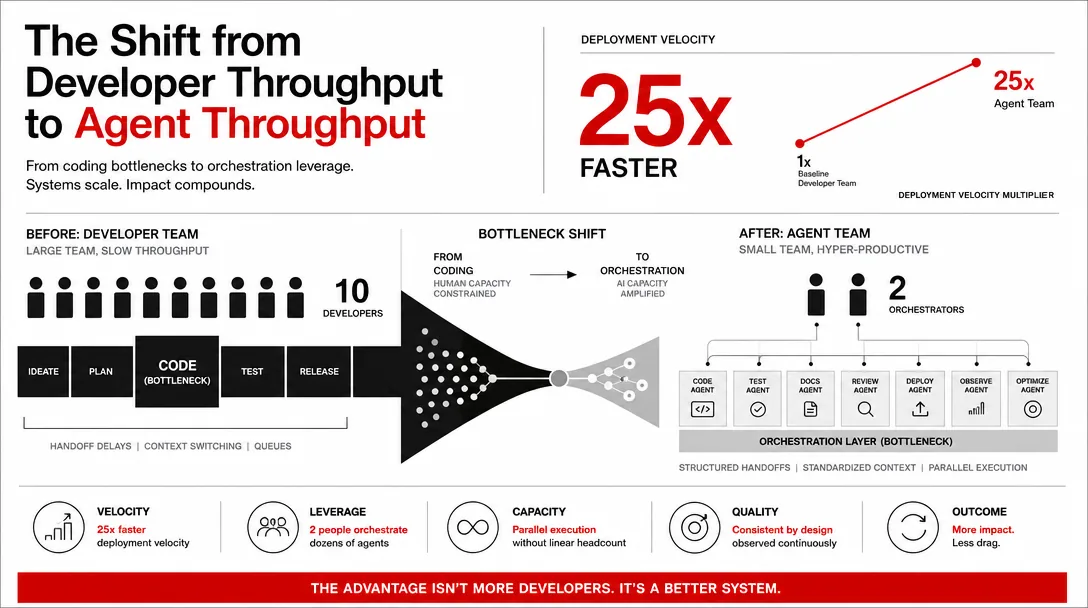
A number like 25x more deploys instantly attracts attention, but the deeper lesson is not about speed in isolation. It is about what happens when agents become the primary unit of execution and the old assumptions of engineering management stop holding. Once implementation can happen continuously, your limiting factor is no longer how fast people type. It becomes how clearly work is framed, how safely output is checked, and how quickly good decisions move.
That is why we focus on agent throughput rather than developer throughput. Teams that bolt AI onto a legacy process often see an early jump, then flatten. The reason is simple: they upgraded the engine but kept the traffic system. Abundant execution collides with slow approvals, vague task definitions, and meetings built for a world where progress was harder to observe.
The practical shift is organizational. You do not win by asking engineers to work beside agents in the same old rhythm. You win by redesigning the flow of tasks, reviews, and handoffs so that fast machine execution is matched by equally disciplined human judgment.
25x
Two engineers working with agents produced twenty-five times more deploys than a team of around ten engineers.
10x
Effective output was estimated by blending ticket count with code complexity rather than relying on weak proxies like PR count.
< 2 months
A delivery pace previously estimated at roughly four months was compressed into under two months.
~20 engineers
The experiment sat inside a broader distributed engineering function, not a toy sandbox or isolated skunkworks.
100M page views
The business context was meaningful production demand, with traffic and reliability expectations that punish slow iteration.
9M drafts
Annual draft volume underscored that speed mattered in a real product environment with constant user interaction.
In the older model, engineering labor was the obvious scarce resource. That is why teams built so much infrastructure around protecting developer time, reducing interruptions, and coordinating handoffs carefully. Those habits were rational when writing, testing, and revising software demanded heavy human effort at every stage.
Now the pressure point is moving. Agents can produce first drafts, implementation variants, and test candidates at a pace that changes the economics of delivery. The expensive part shifts to clear task definition, strong validation, architectural boundaries, and review discipline. If those are weak, faster generation does not create leverage; it creates a larger pile of uncertain output.
This is the key managerial insight: when execution becomes abundant, ambiguity becomes expensive. Teams feel that cost as rework, review fatigue, repeated reframing, and rising hesitation around deployment.
Legacy developer-throughput model
Planning centers on the cost of human implementation. Coordination rituals are designed to protect attention, reduce interruptions, and make partially visible work legible through meetings. Status exchange absorbs significant energy because progress is harder to inspect directly.
Success tends to be framed around keeping engineers unblocked, managing communication edges, and smoothing collaboration across specialists.
Agent-throughput model
Planning centers on the reliability of an execution loop that includes agents, reviewers, tests, and rollback paths. Work becomes visible through artifacts: task state, commits, review queues, test outcomes, and deployment patterns.
Success depends on whether the system converts rapid output into trusted change. That means sharper specifications, faster validation, and better designed interfaces between human judgment and machine action.
Audit your current workflow and ask one blunt question: where does work wait after an agent can already produce a plausible implementation? If the answer is reviews, unclear requirements, fragile environments, or decision bottlenecks, that is your redesign agenda.
Do not start by expanding autonomy everywhere. Start by tightening acceptance criteria, shortening review latency, and making blockers visible in artifacts rather than status narration. That is how you turn agent speed into organizational speed.
When work artifacts update faster than meetings can summarize them, the meeting becomes a lagging interface.
The phrase "agents do not do standups" is memorable because it points to a broader truth. Standups solved a real problem in human-centered execution: people needed a recurring ritual to answer what was done, what comes next, and what is blocked. That made sense when progress lived mostly in heads, conversations, and incomplete local context.
In an agent-heavy workflow, those answers are increasingly visible in the work itself. Task state changes, commits, test outcomes, dependency graphs, and review queues can reveal more than a verbal recap ever could. Meetings still matter, but their job changes. They should resolve uncertainty, settle tradeoffs, and align on risk—not replay information that the system already knows.
Teams that miss this shift often recreate bottlenecks at the coordination layer. They accelerate execution, then slow it back down with rituals built for a different era.
Agents compress the cost of getting from idea to plausible implementation. That does not make the output automatically correct or maintainable, but it changes what you can afford to try, compare, and discard.
Leaders should stop treating implementation effort as the main planning unit. Once first drafts are plentiful, the system must be optimized for narrowing scope, choosing among options, and promoting only the work that survives scrutiny.
More code is not the same as more progress. When teams rely on weak proxies such as PR count or lines of code, they confuse motion with shipped confidence.
The stronger measure is validated output: work that passed clear acceptance criteria, survived review, and can be deployed or rolled back safely. Validation quality becomes the new control surface of the organization.
Strong engineers still matter, but clean interfaces matter more than many teams admit. Agents perform best when ownership is clear and the problem space is legible.
Modularity is no longer just an architectural preference. It is an operational advantage. The clearer the boundary, the faster both humans and agents can move without creating hidden collisions.
In a traditional setup, managers often spend energy on supervision, pacing, and process enforcement. In an agent-centric model, the decisive work moves into designing how tasks enter the queue, where approvals sit, and what quality signals are trusted.
That is a shift toward high-trust production loops. The best leaders will design systems that make good output easy to validate and bad output easy to catch and reverse.
A simplified flow from task definition to safe deployment, showing where human judgment adds leverage rather than friction.
| Signal | Why it matters now | What strong performance looks like |
|---|---|---|
| Deployment frequency | Reveals whether the team can turn output into safe change repeatedly rather than in occasional bursts. | Smaller, trusted releases with fewer coordination delays and clearer recovery paths. |
| Unblocking time | Shows how quickly valuable work stops waiting on dependencies, approvals, or missing context. | Dependencies are resolved early enough that adjacent work can begin sooner. |
| Review latency | Measures whether human judgment is keeping pace with machine-generated execution. | Reviews happen fast enough to preserve momentum without lowering standards. |
| Task clarity | Indicates whether agents are acting on legible instructions or thrashing through reframing. | Higher first-pass success and fewer rewrite cycles caused by ambiguity. |
| Rollback confidence | Separates teams that can experiment safely from those that fear their own output. | Changes can be reversed quickly with disciplined release practices. |
| Coordination drag | Exposes how much time is still spent narrating status instead of making decisions. | Meetings focus on tradeoffs, risk, and prioritization rather than recap. |
A dramatic increase in deploys is visible, but timeline reshaping is often the more durable advantage. When one engineer becomes unblocked in under a month instead of waiting around three months, the gain is not only speed on a single stream of work. It is the ability to start adjacent features, test assumptions earlier, and surface dependency problems before roadmap lock-in hardens.
That creates optionality. And optionality compounds faster than raw output alone.
< 1 month vs ~3 months blocked time
Engineering organizations were built around scarce human implementation capacity. Meetings, approvals, and handoffs evolved to manage that scarcity.
Teams introduced AI tools into existing workflows and saw local gains, but coordination patterns remained largely unchanged.
Agents now compress implementation enough that review quality, validation speed, and task clarity begin to dominate throughput.
The strongest organizations will redesign their coordination layer first, treating management as interface design rather than supervision.
A two-person team will often move faster than a larger group simply because it has fewer communication edges. You should discount headline multipliers before turning them into forecasts.
But do not miss the structural signal. Even after removing some of the excitement, the same pattern remains: faster unblocking, higher deploy cadence, and compressed build timelines reveal that the hidden math of the org chart is changing.
The broader implication reaches beyond engineering. Any function organized around scarce expert execution—marketing, research, operations, support—will feel a similar shift once AI increases the supply of first-draft work. Rituals that once protected expensive human production time must now justify themselves against a faster, more inspectable execution layer.
Most organizations are still in the transition stage. They add tools, keep the same approvals, preserve the same meeting cadence, and hope incremental gains will stack into transformation. Usually they do not. The advantage goes to teams willing to redesign workflow around abundant execution and scarce judgment.
That is the real question under the headline. Not whether agents can produce more, but whether leadership will rebuild coordination, trust, and recovery around that reality before competitors do. In the next phase of organizational performance, throughput belongs to the teams that redesign the system—not just the ones that buy the tools.