Technical Context:
We treat Reflexion and decoupled search as operating patterns, not abstract ideas. When learning is stored as retrievable infrastructure instead of buried in transcripts, AI work stops resetting to zero.
The next advantage in AI work will not come from squeezing one more instruction into a prompt. It will come from building systems that capture outcomes, convert them into memory, and reuse that judgment on the next relevant attempt.
We treat Reflexion and decoupled search as operating patterns, not abstract ideas. When learning is stored as retrievable infrastructure instead of buried in transcripts, AI work stops resetting to zero.
Most teams still overinvest in prompts and underinvest in memory. They build elegant orchestration, save favorite instructions, and celebrate faster outputs, yet their systems repeat the same mistakes a week later. That is the central failure mode of modern AI operations: generation improves, but learning does not.
The correction is straightforward, even if the implementation requires discipline. Each meaningful attempt should produce an evaluable outcome, a clear lesson, a durable record, and a retrieval trigger for future work. Without that chain, what looks like sophistication is often transactional intelligence wearing the clothes of a system.
We see the strongest gains when teams stop treating chat history as memory. A transcript is evidence that work happened. It is not, by itself, a reusable asset. Usable memory is distilled judgment: specific enough to test, structured enough to retrieve, and narrow enough to apply when the next comparable task begins.
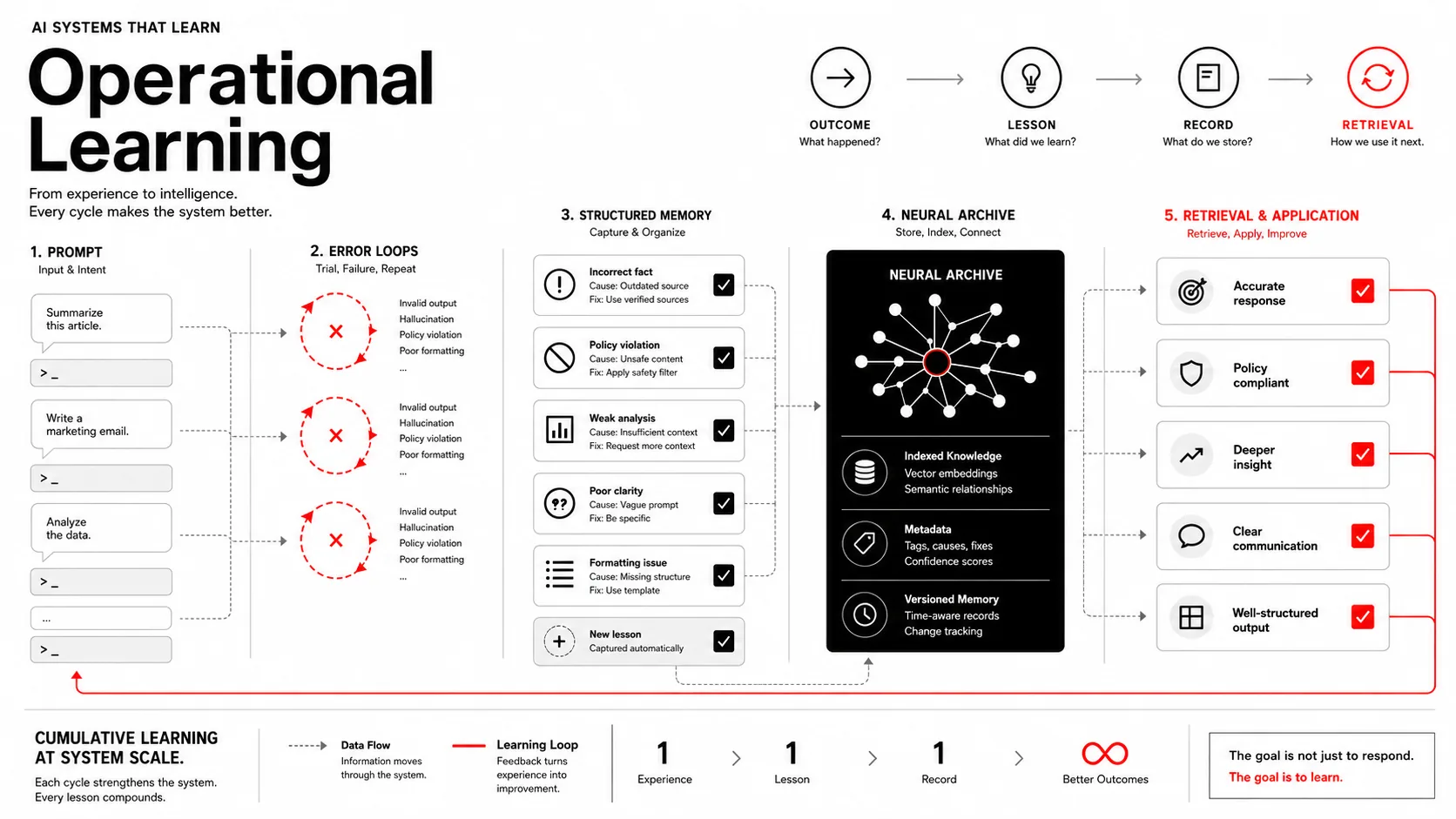
The market has already absorbed the language of learning systems. Teams talk about memory layers, agents, orchestration, and compound workflows as if the hard part were settled. It is not. The hard part is making learning operational every time work is done, not only when someone remembers to document it. Routine retrieval matters more than rhetorical agreement.
Three years after Reflexion was named, the gap remains wider than it should be because many implementations still collapse evaluation, storage, and reuse into vague habits. People notice a result was weak, but they do not record why in a retrievable form. They save notes, but they do not define when those notes should reappear. The system accumulates artifacts, not judgment.
That distinction becomes decisive as volume rises. A prompt can help once. A workflow can help repeatedly. But only a workflow with reflection plus retrieval gets better with experience. Otherwise you are paying for intelligence one turn at a time and calling it progress.
Transactional AI Workflow
Work starts with a fresh prompt, gathers research inside the same thread, and ends when the output is delivered. Any lessons remain implicit or scattered across chats, notes, and individual memory. Improvement depends on the next operator remembering what went wrong.
This model feels fast because everything happens in one place. In practice, it hides error sources and makes repeated work surprisingly fragile.
Compound Learning Workflow
Work is split into distinct layers: action, evaluation, memory capture, storage, and retrieval. Search can widen externally while decision authority stays constrained in the reasoning layer. Each cycle leaves behind reusable operational memory that the next attempt can inherit.
This model is slower to design and faster to improve. Over repeated cycles, source quality, framing, and consistency all begin to compound.
If you want a system to learn, design for retrieval before you design for storage. A long transcript can preserve context, but it rarely surfaces the one lesson that matters at the next moment of execution.
Capture the smallest useful unit: a testable observation tied to a task pattern, decision condition, or failure mode. Then define the trigger that should recall it. Memory without activation is archive, not advantage.
1
Run the task in a bounded workflow with clear decision ownership.
2
Check outcomes against concrete quality signals, not vague impressions.
3
Write the lesson as a specific observation about what changed performance.
4
Save the lesson as a discrete, retrievable memory item rather than a buried transcript note.
5
Inject relevant memory into the next similar attempt before work begins.
The loop is simple enough to remember and difficult enough to enforce. Most users reach step two and stop. They recognize whether an output was good or bad, but they never convert that recognition into a durable artifact. That is why so many AI stacks feel busy without becoming wiser.
The quality threshold for capture is higher than many teams expect. “Use shorter prompts” is too vague to travel. “When a task includes three competing goals, rewrite them into a ranked order before execution” is different. It is specific, testable, and reusable. Good memory survives context changes because it describes a condition and an intervention.
Once retrieval becomes default behavior, improvement stops depending entirely on prompt craft. It starts depending on better accumulation. That is the shift that changes economics: every completed task can add value to the next one instead of disappearing into operational exhaust.
A strong reflection names the condition, the intervention, and the observed effect. Weak reflections describe feelings or preferences. Strong reflections create a usable bridge between one attempt and the next.
Quality rule: if the lesson cannot be checked on a future task, it should not enter memory.
Search and reasoning should not be forced to do the same job in the same moment. When one model call is asked to search, summarize, compare, weigh tradeoffs, and make a decision, the result often looks efficient while hiding where quality actually failed. Blended cognition is hard to debug.
The cleaner pattern is decoupled search. Let one process explore widely, collect references, and filter obvious noise. Let another process hold narrow decision authority over interpretation, tradeoffs, and recommendations. Then let memory record what proved useful across both layers. This separation reduces overload and makes improvement traceable.
Design your systems so external exploration stays broad while decision rights stay constrained. Coverage helps search. Constraint helps judgment. Explicit capture helps learning. If those functions blur together, teams end up adding more tooling without improving the part that matters most.
| LAYER | PRIMARY JOB | FAILURE IF MISSING | DESIGN PRINCIPLE |
|---|---|---|---|
| Search | Explore external information with breadth and filter candidate sources | Weak evidence enters the workflow or strong evidence is never found | Favor coverage and structured collection |
| Reasoning | Interpret evidence, rank tradeoffs, and keep conclusion authority narrow | Outputs become verbose, inconsistent, or overfit to noisy context | Favor constraint and explicit decision logic |
| Memory | Store verified lessons from completed attempts and resurface them later | The same errors repeat across sessions and operators | Favor retrievability and verifiability |
Illustrative comparison based on the operational pattern described in the article: compounding begins once retrieval becomes routine.
Because prompting is visible and memory infrastructure is not. Teams can demo a polished interface or a fast automation in minutes, while retrieval design lives inside rules, schemas, and triggers that rarely get social attention.
There is also a conceptual bias at work. Many operators still treat intelligence as the product, when the durable edge comes from how intelligence is organized across time.
A verifiable reflection can be checked against a future task. It names the context, the change made, and the effect observed. “Be more strategic” fails that test because no one can tell what should change next.
A stronger version would specify that responses improved when recommendations included one explicit tradeoff and one measurable outcome. That can be reused, tested, and either reinforced or discarded.
Because the same pattern governs institutional learning. When judgment stays trapped in individuals, onboarding slows, recurring mistakes repeat, and strategic continuity depends on who happens to be present.
Persistent memory turns expertise into shared infrastructure. That improves quality not only for agents and analysts, but for any team doing recurring work under changing conditions.
The broader implication is not merely technical. Organizations are moving from a world where access to intelligence was scarce to one where access is abundant and retained judgment becomes the differentiator. That changes where leaders should invest attention. Not only in better models, but in cleaner bridges between action, reflection, and reuse.
This is why small teams can outperform larger ones with more tooling. If a team captures what worked, stores it in a form that can be found, and retrieves it before the next attempt, it builds continuity that scale alone does not guarantee. Institutional memory stops living only in senior staff, scattered documents, or lucky repetition.
The real question now is not whether models will keep improving. They will. The decisive question is whether your workflow can remember what improvement actually looked like. Build that layer first, and AI stops behaving like a clever assistant. It starts behaving like a system that learns.