Core framing:
the decisive advantage is not faster output. It is the ability to design work loops where agents, humans, memory, and judgment operate as one managed environment.
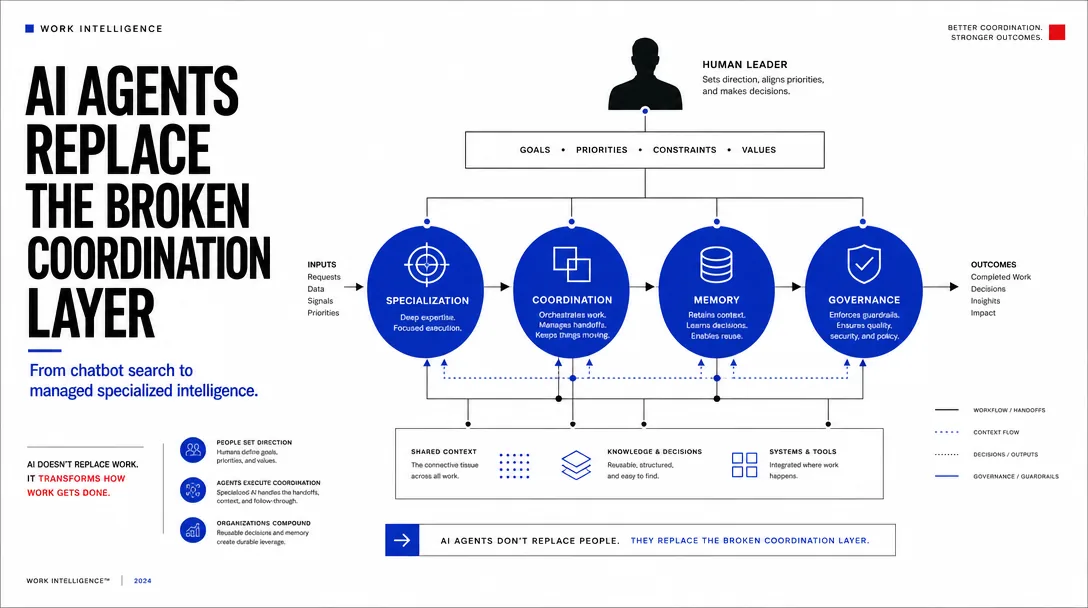
AI agents are changing the unit of productivity from isolated task completion to coordinated work systems that preserve context, act on objectives, and compound institutional memory.
the decisive advantage is not faster output. It is the ability to design work loops where agents, humans, memory, and judgment operate as one managed environment.
AI agents matter because they alter the basic shape of work. For decades, software helped professionals move faster inside discrete tasks: build a spreadsheet, update a dashboard, send the email, close the ticket. The person still carried the thread across tools, decisions, context, and follow-up. Agents begin to carry part of that thread, turning isolated execution into coordinated intelligence.
That shift is subtle, but it is structural. A chatbot helps in a moment; an agent participates in a workflow. When agents can hold objectives, monitor changes, use tools, coordinate with other agents, and return with work already advanced, productivity stops being only about speed. It becomes about continuity across the gaps where knowledge work usually leaks value.
The strategic question is no longer “Which task can we automate?” The better question is: which work loops deserve persistent intelligence, shared memory, and clear human judgment at the boundary?
Speed is the obvious benefit, which is why it dominates early AI adoption. Summaries arrive in seconds. Drafts appear before the meeting ends. Research that once consumed an afternoon becomes a structured brief. Useful, yes — but speed alone still leaves the organization dependent on humans manually reconnecting decisions, tasks, records, and follow-up.
The deeper transformation is stateful work. Agents can preserve context, monitor for change, and act when a threshold is crossed. A decision from a customer call can become a task, a task can update a project, and a project can retain a decision trail. This is where AI stops behaving like a clever interface and starts behaving like part of the operating layer.
Continuity makes work compound. Without it, faster work simply creates faster fragmentation.
Task acceleration
A professional asks for a document summary, proposal outline, spreadsheet analysis, or draft email. The output is faster, but the human still decides where it belongs, what it changes, who needs to know, and whether the underlying system should be updated.
Work continuity
An agent tracks the objective beyond the immediate request. It connects the output to a task state, project record, decision log, or follow-up action. The value comes from carrying context forward, not merely producing the next artifact faster.
A durable agent workflow needs more than a prompt. It needs a managed loop with a condition, an objective, a feedback mechanism, and a clear boundary for human review.
4 operating elements
1
A single agent can create impressive output, but its value remains local unless it is connected to memory, ownership, and state.
20
Twenty agents can generate chaos when there are no shared rules for escalation, storage, task status, or decision authority.
5
Effective agent delegation requires outcome, context, constraints, evidence, and a completion standard.
Traditional automation works best when the process is stable: if this happens, do that. Agents are different because they can interpret ambiguous input, ask for clarification, choose tools, and adapt based on outcome. This moves work away from rigid task chains and toward managed loops that learn from their own history.
Content operations make the difference visible. A task process says: draft the post, create social posts, send the newsletter, update the calendar. An agentic loop asks which customer conversations contain emerging themes, which themes have enough evidence to publish, which assets are underperforming, and which ideas deserve deeper research before public release.
The first model moves content through stages. The second improves the content function itself. That is the practical meaning of compounding workflow intelligence.
| Work layer | What agents absorb | What humans must sharpen |
|---|---|---|
| Research collection | Finding, grouping, and comparing source material across tools, notes, conversations, and prior work. | Defining what evidence is credible, which questions matter, and when research is sufficient. |
| First-draft synthesis | Turning unstructured input into briefs, outlines, decision records, emails, documentation, and status updates. | Setting the standard for clarity, taste, risk, and strategic usefulness. |
| Task routing | Connecting conversations to tasks, tasks to projects, and projects to follow-up actions or status events. | Owning priority, sequencing, tradeoffs, and accountability for outcomes. |
| Knowledge retrieval | Surfacing relevant prior work, examples, constraints, and decision history when a new request appears. | Maintaining the knowledge base so retrieval reflects reality rather than stale memory. |
Do not begin by asking which agent platform has the most features. Begin by mapping the loop: trigger, objective, evidence source, human review point, storage destination, and success signal. Tool selection becomes clearer once the operating model is visible, and shallow adoption becomes easier to avoid.
When execution becomes cheaper, judgment becomes more valuable. Agents will absorb fragments of roles before they absorb roles entirely: research collection, first-draft synthesis, task routing, routine follow-up, knowledge retrieval, and status reporting. These fragments matter, but they do not equal the full value of a professional.
The remaining value concentrates around sharper questions. What matters? What should be ignored? Which tradeoff is worth making? What outcome is the work serving? Where does human trust matter? Professionals who treat AI as a faster keyboard get incremental leverage. Professionals who design work around coordinated judgment build strategic advantage.
This is not a demotion of expertise. It is expertise made more visible.
An agent should not receive only an activity request such as “analyze this” or “write that.” Define the end state: a decision record ready for approval, a customer pattern categorized by evidence strength, or a proposal outline aligned to a specific buying context. Clear outcomes reduce rework and make delegation reusable.
Agents perform better when they understand the business situation around the task. Include relevant history, audience, constraints, prior decisions, and the reason the work matters now. Context is the difference between generic output and operationally useful work.
A capable agent can still optimize in the wrong direction. State what it must avoid: unsupported claims, unapproved pricing language, customer-sensitive data, speculative recommendations, or changes to source records without review. Boundaries turn autonomy into controlled leverage.
Delegated work should specify which sources are acceptable and what should happen when evidence is missing. Agents need access to documented decisions, examples of good work, knowledge bases, project history, and trusted datasets. Better evidence reduces hallucination risk and improves consistency.
The completion standard tells the agent what “good” looks like. It may include structure, tone, review criteria, required fields, confidence threshold, or escalation conditions. This is managerial clarity, not prompt decoration, and it becomes more valuable as workflows repeat.
One agent can summarize a report. Another can generate sales copy. Another can monitor tasks, analyze support patterns, or update documentation. Each capability looks valuable in isolation. Together, they create a harder question: who decides what matters, what gets stored, what gets ignored, and what gets escalated?
This is where agentic work becomes operational design. Multi-agent environments need ownership boundaries, shared memory rules, task states, escalation paths, and standards for when an agent acts independently versus when it requests confirmation. Without those controls, the system produces more activity than progress.
The practical lesson is direct: coordination beats capability once agents gain reach. Prompts are not enough; the environment needs an operating model.
The tool layer matters. The operating layer matters more.
Treat documentation as an active asset, not a storage chore. Agents need decision records, examples of good output, constraints, and prior work to avoid recreating the same analysis. A weak knowledge base produces weak agent performance — not because the model lacks intelligence, but because the environment lacks durable memory.
The most common failure mode is not ignoring agents. It is adopting them shallowly: AI writing tools here, meeting summaries there, research assistants somewhere else, a few workflow automations on top. Output increases, activity rises, and the organization feels busier in a more modern way. Yet the underlying work design remains unchanged.
When execution becomes abundant, scarcity moves elsewhere. Clear priorities become scarce. High-quality context becomes scarce. Trustworthy judgment, taste, and strategic restraint become scarce. Agents can produce options, but they cannot decide what kind of organization you want to become. They can accelerate a workflow, but they cannot make a confused objective coherent.
The future of work is not a clean replacement story. It is a reallocation story: machines absorb more execution, while humans hold more responsibility for direction. The winners will not be the teams collecting the most tools; they will be the teams building compounding work systems with intention.
Design your limits, approvals, memory, and recovery paths before expanding autonomy. That is how agents become more than shortcuts. They become coordinated intelligence: work that remembers, adapts, and improves under human judgment.