NOR-TIC Perspective:
The real moat is not faster prompts. It is an intelligence layer that captures your decisions, standards, and corrections so your system becomes more specific every week.
Most professionals don’t fail with AI because models are weak. They fail because nothing in their workflow compounds into a durable advantage.
The real moat is not faster prompts. It is an intelligence layer that captures your decisions, standards, and corrections so your system becomes more specific every week.
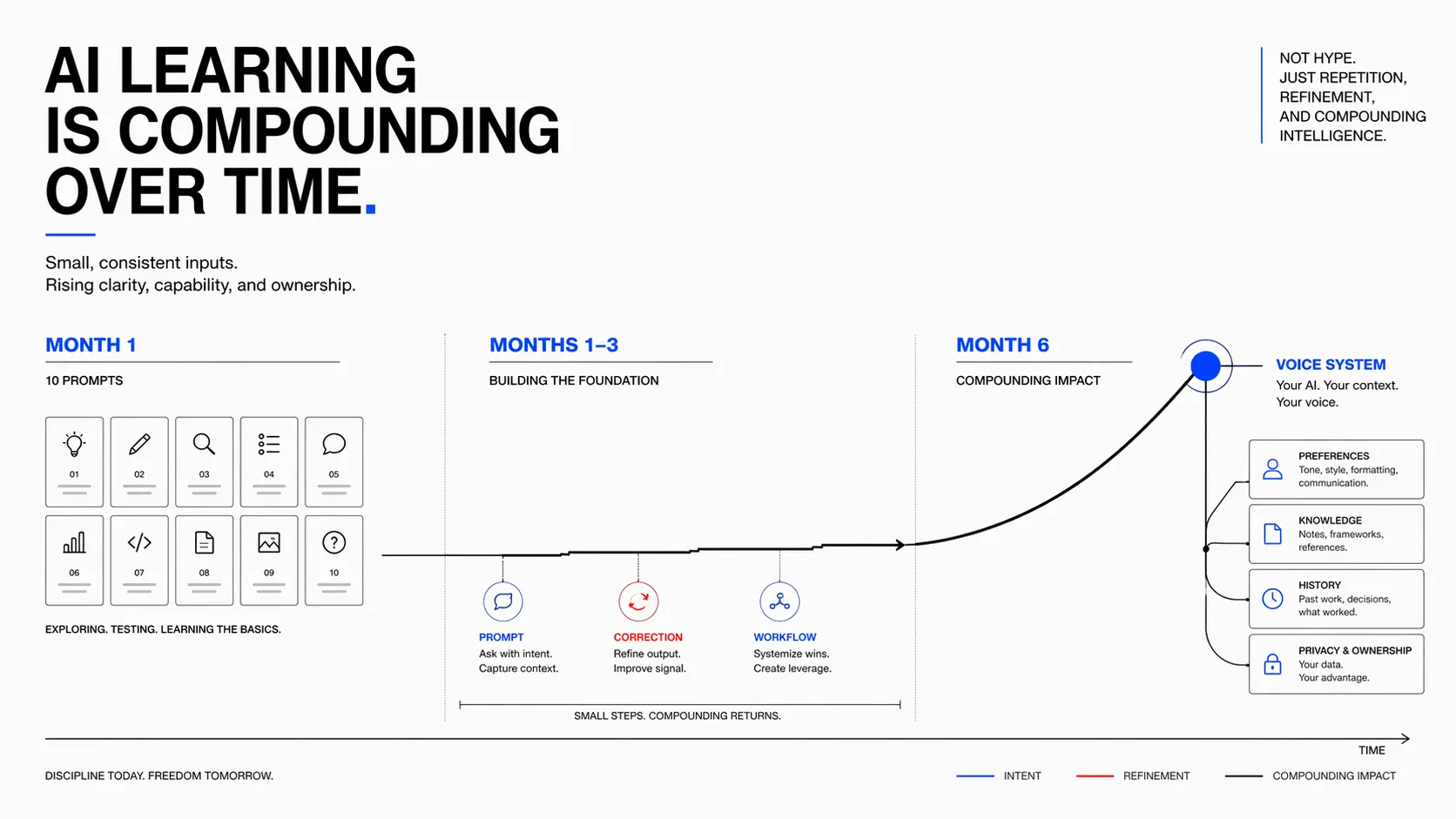
We see the same pattern repeatedly: month one feels productive, month two feels noisy, month three feels optional. People save ten prompts, get a few strong drafts, and assume they have “adopted AI.” But saved prompts are not a system. Without memory, standards, and retrieval, you are still operating with disposable interactions.
The inflection point comes when every correction becomes a future advantage. When your assistant reflects how you frame offers, reject weak reasoning, and sequence client work, output quality stops being random. That is when AI shifts from novelty to infrastructure. That is the curve most teams underestimate.
The biggest failure mode is shallow integration. If your assistant never absorbs your operating constraints, every session starts close to zero. You re-explain context, restate preferences, and rewrite tone. That creates context reset costs that quietly erase productivity gains.
For self-employed experts, this becomes expensive quickly. At $200+ per hour, the problem is lost continuity. Every restart means your judgment stays trapped in your head instead of entering a reusable layer. Teams that win treat each interaction as training data for future decisions, not as a one-off request.
A tool can look impressive in demos and still fail in daily practice if trust never compounds.
10 saved prompts
Initial momentum appears, but capability is mostly manual and fragmented.
Pattern emergence
Documented structures, stored decisions, and repeated workflows begin reinforcing each other.
Voice fidelity
Drafts reflect your judgment model, not generic model defaults.
Design your workflow so every interaction leaves residue: a decision rule, tone correction, reusable source, or structure pattern. If an exchange does not improve tomorrow’s performance, it is operationally wasted. Build weekly reviews that ask one question: what became easier because we captured it?
Rented Intelligence
Optimized for immediate output quality. Useful for quick drafts, ad-hoc brainstorming, and low-context tasks. Little long-term memory of your standards, so each session has setup overhead. Easy to replace, but also easy to outgrow when work depends on nuanced judgment.
Owned Intelligence
Optimized for accumulation. Captures recurring decisions, preferred structures, and rejection criteria so quality improves with use. Setup feels slower early, but compounding judgment increases speed and confidence over time. Harder to replace because it contains your working history, not just generic capability.
The goal is a repeatable capture loop that converts daily work into durable capability. Use one knowledge store, one workflow tracker, and one weekly review ritual. Keep identifiers stable so retrieval improves over time.
knowledge_base.Target: 1 reusable artifact per workday
You identify repeated explanations, tone mismatches, and scattered source material. Output is inconsistent, but failure points become visible.
Prompt templates, decision logs, and source indexing reduce repetitive setup. Early gains appear in draft speed and recall quality.
Corrections are fed back intentionally, turning edits into reusable standards. Trust begins shifting from session-based to system-based.
The stack starts cross-referencing prior insights. Work feels less like prompting and more like directing an intelligence layer shaped by your methods.
Start with recurring decisions, not random ideas. If a judgment appears twice in a month, it belongs in your system with context and rationale. This creates immediate reuse and reduces second-guessing in future work.
Measure reduction in context restatement and revision loops. If proposals, emails, and synthesis drafts need fewer corrective passes after 30 days, your layer is learning your standards. Personalization is operational when quality improves before you intervene.
Switch only when migration preserves your captured judgment. If you move platforms but lose decisions, taxonomy, and correction history, you reset the curve. Tool changes should improve throughput without destroying accumulated intelligence.
| Signal | Weak Adoption Pattern | Compounding Pattern |
|---|---|---|
| Prompt Use | Saved once, rarely iterated | Versioned and refined against outcomes |
| Knowledge Storage | Scattered across chats and docs | Centralized with tagged retrieval |
| Quality Control | Subjective, session by session | Defined standards with explicit reject criteria |
| Business Impact | Short bursts of speed | Sustained lift across 100-day horizon |
As model quality converges, differentiation moves up the stack. The advantage will belong to professionals who can retrieve their own judgment faster than competitors can generate generic text. That means architecture decisions now are strategic, not technical housekeeping.
If your system cannot answer “where do corrections go?” you are not compounding yet. If it cannot show what became easier after 30 and 90 days, you are still buying output, not building capability. The shift is simple and demanding: prioritize continuity over novelty.
In practical terms, your edge becomes the fidelity of your memory, the clarity of your standards, and the speed of your retrieval.
The professionals who stay in the game will not be the ones with the most tools. They will be the ones who turned lived experience into an asset that compounds across clients, decisions, and deliverables. This is why our guidance is direct: stop chasing the most impressive demo and start building the system that becomes unmistakably yours.
Six months from now, the gap will be obvious. One path delivers temporary assistance. The other delivers owned intelligence that thinks in your voice and improves with every cycle.
Choose the path that stores your judgment, because that is the part of AI that gets more valuable as everything else gets cheaper.