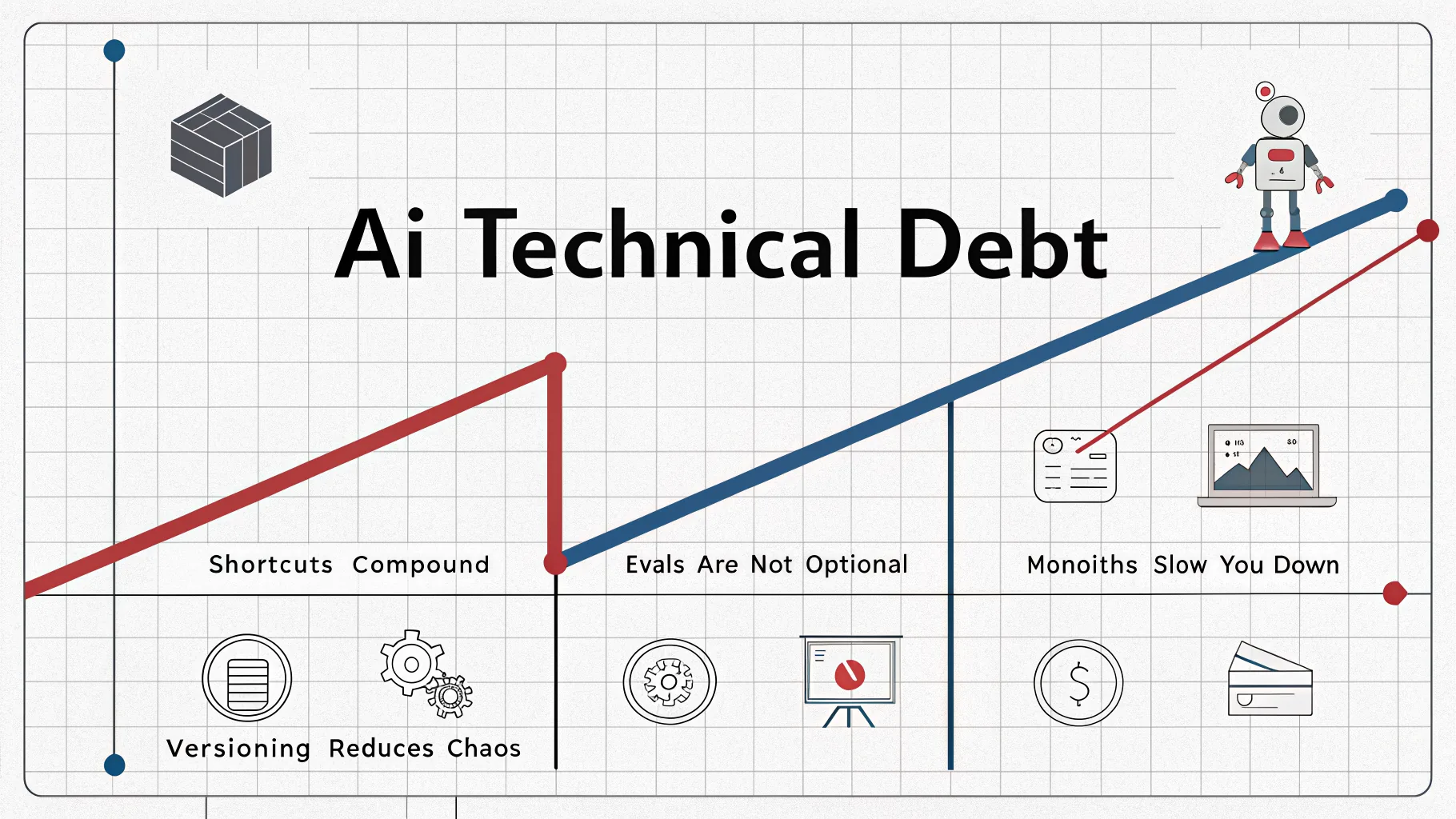
AI products rarely fail because teams moved too slowly. They fail because speed masked fragile prompts, weak evaluation, unclear ownership, and architecture that could not absorb change. Durable machine learning delivery starts when you treat maintainability as part of product quality, not a cleanup phase.
N NOR-TIC9 min read
AI Insights
LLM
Strategy
Best Practices
Summary & background
Technical Context:
AI debt is not just brittle code. In LLM and machine learning systems it compounds through prompts, retrieval, model routing, data lineage, and security controls. The teams that scale safely design boundaries before expanding capability.
In this article4
AI technical debt is the future cost created by shortcuts that feel harmless in the moment. A prompt patch resolves today's edge case. A manual review step keeps the pilot moving. A broad permission rule avoids friction during testing. Then six months later, the product becomes slower to improve, harder to secure, and more expensive to trust. Hidden maintenance cost is what turns an exciting AI launch into operational drag.
The reason this debt grows so quickly is structural. A simple interface can conceal prompts, retrieval logic, embeddings, vector storage, model routing, formatting, permissions, monitoring, and fallback rules. Each layer can fail differently, and each quick fix can push complexity into another layer. In AI systems, dependency chains multiply faster than most product roadmaps acknowledge.
That is why maintainability must be designed early. Speed without instrumentation looks efficient only in phase one. After that, every improvement depends on whether your team can explain what changed, why quality moved, and who owns the resulting behavior.
AI complexity stays invisible until change exposes it
Teams often underestimate AI debt because the product surface looks deceptively small. A chatbot appears to be one interface and one model call. In reality, the experience may depend on retrieval quality, document freshness, access rules, post-processing, output schemas, and cost-based model routing. Visible simplicity can sit on top of a deeply coupled stack.
A common escalation path is easy to recognize. The team launches with one strong prompt, then adds conditional logic when edge cases appear. Retrieval gets bolted on for accuracy. A second model enters for cost control. Logging remains partial. Evaluation stays manual. The user still sees a polished interface, but internally the system has become hard to reason about. No single team member can say which change improved or damaged performance.
The real risk is not complexity itself. It is untracked complexity. When handoffs, versions, and ownership are explicit, even sophisticated multi-layer systems can evolve cleanly. When they are implicit, every change becomes a negotiation with unknown dependencies.
How a simple prototype becomes a debt-heavy AI stack
A linear escalation from initial prompt-based launch to a difficult-to-govern system, showing how shortcuts compound when measurement and ownership lag behind feature growth.
Single prompt launch
Edge-case fixes via conditions
Retrieval added for accuracy
Second model for cost routing
Partial logging
Manual evaluation persists
Low diagnosability in production
Connections
Single prompt launch → Edge-case fixes via conditions
Edge-case fixes via conditions → Retrieval added for accuracy
Retrieval added for accuracy → Second model for cost routing
Second model for cost routing → Partial logging
Partial logging → Manual evaluation persists
Manual evaluation persists → Low diagnosability in production
Strategic debt
Strategic debt is a conscious, limited tradeoff. The shortcut is documented, tied to a narrow scope, assigned to a clear owner, and paired with an exit trigger. A temporary manual evaluation workflow can be acceptable when the team knows exactly when production volume, risk, or complexity requires replacement. Temporary by design is fundamentally different from temporary by hope.
Reckless debt
Reckless debt is a shortcut without boundaries, timing, or accountability. The team says the workflow is provisional, but nothing in the codebase, release plan, or operations model marks it as such. Once adoption grows, undocumented prompt logic, broad permissions, and ad hoc testing become inherited architecture. Undefined replacement paths are what turn experimentation into long-term drag.
Treat every shortcut as a governed asset
If a team cannot answer who owns a temporary workflow, when it expires, and what will replace it, the shortcut is already becoming structural debt. Document the tradeoff at the moment you make it. Add a review trigger tied to usage, risk, or scale so the fix is not postponed indefinitely.
This is especially important for prompt-heavy products. Prompts, retrieval rules, and manual review steps may look lightweight, but they often carry core business logic. Govern them with the same seriousness you apply to application code.
02Core Failure Modes
The biggest risks appear long before the model looks broken
0
PROMPT GOVERNANCE
rollback path in many rushed deployments when prompts live in notebooks, env files, or chat threads
5 vs 500
EVALUATION COVERAGE
anecdotal wins on five examples can still hide worse performance across five hundred representative cases
10 tasks
BASELINE STARTER
a lightweight test set with explicit scoring rules is enough to create an initial quality baseline
Phase 1
SECURITY TIMING
permissions, logging limits, provider approval, and retention rules need architectural presence early
Prompts become dangerous when teams treat them like convenient text instead of governed production assets. In many LLM products, the prompt carries policy, business rules, formatting expectations, and exception handling. A small wording change may improve one scenario and quietly degrade another. Without baselines or rollback, prompt drift becomes invisible infrastructure.
Evaluation gaps create the next layer of debt. Many teams still rely on visual inspection, anecdotal testing, or internal confidence. That works only at tiny scale. Once prompts, models, or datasets change regularly, improvement without measurement becomes guesswork. Confidence without evidence is one of the fastest ways to waste two weeks on tuning that performs worse in aggregate.
Data dependency risk is quieter but often more damaging. Retrieval pipelines can index outdated source material, metadata conventions can drift, and access controls can degrade context quality without causing system failure. The application remains available, yet trust erodes. That is the defining challenge of AI operations: plausible wrongness is harder to catch than obvious breakage.
The visible symptom is rarely the root cause. Most debt shows up first as uncertainty, not total failure.
Risk surface
What teams usually see
What is actually happening
Operational consequence
Prompt logic
Fast iteration on wording
Business rules are living in uncontrolled text assets
Changes become hard to audit or roll back
Evaluation
A few outputs look better
No baseline exists across representative tasks or versions
Optimization effort cannot be trusted
Data lineage
The system still returns answers
Inputs are stale, incomplete, or permission-distorted
Reliability drops without visible outages
Security
Controls can wait until adoption
Sensitive context is already flowing through weak boundaries
Retrofitting becomes expensive and disruptive
Architecture
The prototype shipped quickly
Model, retrieval, memory, and interface are tightly coupled
Every future change carries broad regression risk
Complexity is manageable. Untracked complexity is what compounds debt.
03Designing For Durability
Reduce AI debt with boundaries, baselines, and replacement paths
01
Boundaries
02
Baselines
03
Replacement Paths
The most reliable way to reduce AI debt is to separate the system into components that can change independently. Prompts should not quietly absorb policy logic. Retrieval should not compensate for weak document governance. Orchestration should not become the only place where product rules are understood. Clear component boundaries make failures diagnosable and ownership visible.
Baselines come next. Before repeated iteration begins, define prompt versions, model versions, test sets, scoring criteria, latency expectations, and cost thresholds. This does not require a heavyweight lab. Ten representative tasks with explicit scoring rules are enough to create a starting point that turns future tuning into evidence rather than intuition. Lightweight measurement beats endless unstructured experimentation.
Finally, define replacement paths. Every temporary choice should carry a trigger for change: manual review until volume crosses a threshold, one-model deployment until routing criteria justify specialization, or hard-coded prompts until governed version control is in place. Managed replacement is what keeps early speed from becoming inherited architecture.
Operational checklist for maintainable AI delivery
Use this checklist before expanding an AI workflow beyond pilot usage. The goal is not to eliminate every shortcut. The goal is to make sure each shortcut is bounded, measurable, and replaceable.
Store prompt and model changes in governed version control, not only in notebooks or chat threads.
Create a baseline set of 10 representative tasks with explicit scoring rules before major tuning cycles.
Document approved data sources, freshness expectations, and ownership for retrieval pipelines.
Separate model selection, retrieval, orchestration, evaluation, and interface concerns so one layer can change without forcing a rewrite.
Define security controls early: permission scope, logging limits, provider approval, and retention handling.
Assign a named owner to every temporary workflow and set the condition that triggers remediation.
The leadership question that changes design decisions
Do not ask only how fast the team can ship the feature. Ask what will make the system expensive to maintain in 180 days. That single reframing moves evaluation forward, exposes ownership gaps, and forces teams to think about modularity before user expectations harden.
It also protects ROI. Many AI initiatives look cheap in phase one because the maintenance bill has not arrived yet. Good planning is how you prevent future capability from being trapped inside today's shortcut.
04NOR-TIC's read
AI technical debt is often a planning problem disguised as a model problem. When output quality drops, teams instinctively blame the model first. In practice, the deeper issue is usually elsewhere: weak data hygiene, missing evaluation, brittle prompt logic, deferred security, or architecture built around a prototype that was never meant to scale. The model is often carrying upstream decisions it did not create.
The teams that improve fastest are not the ones that avoid every shortcut. They are the ones that take shortcuts consciously, document them clearly, and define what will replace them. That discipline turns debt into a managed tradeoff instead of a hidden liability. If you want AI systems that stay reliable under real usage, design for change from the beginning.
That is the real standard. Long-term speed comes from modularity, measurement, and ownership. Everything else is borrowed time.